Type of Tour: Backpacking
Duration of Tour: 5 Days
Location: Wrangell – St. Elias National Park, Alaska
Tour Operator: St. Elias Alpine Guides
Cost of Tour: US$950
Time of Year: July (Summer)
Overall Experience: 10/10
Would I recommend this Tour? Absolutely!
Link: http://www.steliasguides.com/trip/glacier-and-tundra-backpack-trip/
I was just a few days into the beginning of a near 3 month holiday, and what better place to be than Alaska!!? Over the 5 days that followed I embarked on an excursion with St. Elias Alpine Guides, where I witnessed the untamed beauty of Alaska and lived adventure beyond anything I had previously known.

Day One
I met the group I would grow to love in a short 5 days; our group consisted of two guides Melissa and Chris, and all first time travellers to Alaska; Annie, Kelly, Yara, Luc, Lara and myself. We did our final pack, dispersing tents amongst our pairs, finding space for bear canisters and attaching (what the hell are they!?) crampons (oh.) to our packs. We were then bound for the airstrip located a couple of kilometres up the road, where we were greeted by Wrangell Mountain Air pilots who would take us out in single or two passenger bush planes to an area called The Fosse. I was flown out on the second last plane, and with fairly hefty mountains staring us in the face, I was amazed that the pilot needed only a few short meters to become airborne. 20 minutes later I was dropped at The Fosse where a few of my comrades stood waiting; from this location we would spend 5 days crossing tundra meadows, rugged glaciers, treacherous moraine, and dense forests before making it back to civilisation, and we were all pretty excited to make a start.


From the drop off point we walked on moraine until we reached a grassy meadow with a natural spring; we sat for a short while learning the plants that inhabit the area, and after replenishing our water supplies, we got back to walking. The terrain was different to anything I had walked across before; from tundra (moss like grass that covers the earth creating a springy, sponge like floor) to moraine (a hill made up of loose, jagged rocks that had been pushed from the earth by the force of glaciers), and across tundra again. We eventually found relatively flat ground to make camp, which was completed in pairs. We carried our scented goods and food in bear canisters which we would stored nearby the food preparation area, we found a suitable place for using the bathroom, adhering to the outdoor way ‘leave no trace’. Once camp had been set up, we decided to explore the area, we began climbing the near-veritcle slopes shaped by glaciation, which was exhilarating. We stopped in our tracks where the grass ended and steep rockfall began and took the moment to enjoy our surrounds. From where we stood, we gained a great vantage point of the glacial system and the course we would take in the days that followed. It was well worth the climb, and with the scattered drizzle having reached us, we made back for camp. The journey down the hill was pretty challenging, being on wet grass and at a steep gradient, we marked individual zigzag trails the entire way down.

Day Two
We rose to the brisk summer Alaskan air, after enjoying breakfast and a hot drink, we packed up camp and made way for the glacier. The first section of the day was challenging where we were faced with both climbing and descending moraine. This wasn’t just any old up and down climb, we were descending a near 70° gradient, weighed down with heavy backpacks and battling against loose rocks and ice under foot. After our guide, I was the first to take on the challenge, and challenge it was! Adrenaline, pulsated through me, every step I placed took me an additional length just from the sliding rocks undertow, and after I made it safely down to the glacier, we waited close to an hour and a half for the remainder of our group to join us.


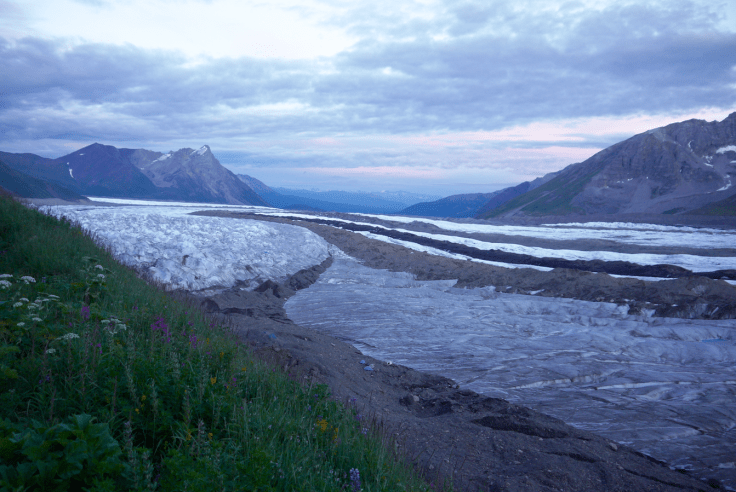
The hours following we learnt to walk in crampons, traversing glaciers and steering clear of crevasses (large cracks across the ice) and moulins (near vertical holes that build from a collection of surface water). We made it across the glacier and onto neighbouring moraine, where we took care in landscaping flatter ground for our camp. By the time camp was set up, the sun made its appearance; casting luminous rays over the majestic Mt Blackburn, it was truly breathtaking. From one natural wonder, to another, we made way for LaChapelle Icefalls (icefalls are formed on a steep part of a glacier, typically coming down a mountain). The icefalls were visually stunning, they were erratic formations, heavily sculptured by crevasses, we found lakes and glacial rivers, and climbed narrow bridges which the icefalls had created.


After having dinner and preparing for bed, I joined the guides in climbing the steep surface of Packsaddle Island. Upon reaching the height of the ridge, we came across a meadow of grass and wildflowers, we wandered along until we found the remains of a young grizzly bear, the probable cause of death was it having fallen from a height, but it could have been anything. All that remained was a fur coat, skull and claws. We walked to the edge of the ridge, taking in the light pastels of the evening sky and eventually made our way back to camp for a well deserved sleep.


Day Three
Day three marked a challenging day, as our energy levels were down and muscles began to ache, it was a long, exhausting haul. We began the day climbing glaciers, and continued climbing glaciers, we walked and walked and walked. We rested as often as we could, and devoured scroggin to keep us moving. We witnessed more amazing glacial formations, from moulins to serpentine rivers. As we neared the end of the glacier, we were confronted by loose moraine, made even harder to traverse with our tired limbs. As we neared camp; we were a rollercoaster of emotion, most of us found laughter in anecdotes. We took great pleasure in learning how to dispose of our bodily waste at this site, in which we would find two decent sized, flat rocks, sandwiching our faeces between the rocks, and launching said sandwich into a moulin.


Once again, we were tasked with landscaping our campsites. The thin layer of rock that covered the glacier meant we would only remove the most prominent rocks, leaving a thin layer of rock between our tents and the ice, surprisingly, this was the best nights’ sleep we had. We kicked up our feet and basked in the accomplishments we had achieved that day, we sat around sharing wonderful stories and laughed into the night.
Day Four
We made tremendous time in covering the glacier, before reaching difficult terrain, consisting of everything between boulders, rocks, and dirt on ice, we walked carefully. As we travelled further down the glacier, we came across raging rivers and fragile ice structures that our guides worked tirelessly to find routes around. It took us most of the day before we reached flat ground, stopping for lunch on the first lake of the basin. We had some serious bush bashing ahead of us, so we ensured everything on the outside of our packs was well secured, or moved to the inner compartments, we covered our bootlaces with our socks and put our raincoats on as an outer shell. This section hike was prime bear territory, and to scare off any looming visitors, we chanted “hey bear” throughout the afternoon. We walked for a period on fairly mild terrain, tundra mounds which were soft cushions, alleviating the joints, and a welcomed change from the foot stomping glaciers and slippery moraine. We hit fairly dense shrubbery as it began to rain, so we ducked and weaved as best we could, trying to avoid spring loaded branches snapping back on us from ahead. I landed a few branches to face and shins, but the pain was forgotten as the high from laughing and joking took its place. It was a thrill to weave between the branches, stomp through mud ditches and hop across rocky crossings, and a definite highlight of the trip. We ate blueberries from scrubs beside the track, and made it to camp around 2000hrs, absolutely drenched (thank god for rain layers). Upon making it to camp, we worked as a team in the pouring rain and erected the tents in no time. We were all damp and cold, so at the instruction of our guides, we hopped into our sleeping bags wearing only thermals. Finally finding warmth, it took only a matter of minutes to fall asleep. Dinner was called around 2200hrs, the guides had worked tirelessly to prepare a wonderful thanksgiving meal, which woke me from my slumber.


Day Five
We started this day with granola and pained legs. At least we were warm, dry and well rested. We headed along the ridge of moraine until we eventually dropped down a few challenging slopes, and onto the Root Glacier. After the rain, the root glacier was left rugged with pools of water. The glacier was tiring to walk across, as we stomped our crampons into the ice. As we neared the end, we found a deep blue, glacial pool, perfect for an invigorating dip. I was eager to test the waters, and having stripped down to my underwear, I carefully crossed the ice to stand at the waters edge. I pin dropped into the water, plunging further and further from the waters surface, when the shock of the water temperature hit me, I hurled myself to the surface as quickly as I could manage. Upon reaching the surface, I tried to fill my lungs with air, which was near impossible from the shock my body was going through, take two, a little more air, take three, I was pulling myself out of the water, breath four; I had regained rhythmic breathing. I felt invigorated, alive, and willing to do the exercise again. Two other girls, Kelly and Annie also braved the plunge, like trampoline work, they sprung out as soon as they had hit the water.


From here, we walked, excited to be nearing civilisation; we made fairly good time from here, only taking a couple of hours to cross the final glacier. After clearing the final section of moraine, we joined an established dirt track that took us the entire way back to Kennecott. As we entered Kennecott, we took in the historic town; far removed from metropolis, yet the faces that filled it reconnected us to civilisation. That moment, I walked amongst 7 new friends, after an experience that will connect us for life, I twirled around, and screamed at the top of my lungs “it’s good to be alive” because I had never quite, felt so gifted.


Overview of my experience:
St. Elias Alpine Guides provided a service offering like no other, I spoke with Gaia over Skype for a long period of time, we discussed: tour offerings, what my competency levels were, what I wanted out of the trip, and more generally; what I wanted out of my time in Alaska. Gaia was able to contribute advice and suggestions towards not just the tour I booked with her company, but the transportation, accommodation, onward destinations and activities that work in with my journey. The guides were knowledgeable, insightful, enthusiastic and an absolute pleasure to spend time with. We learnt about the geography and geology of the land we walked on, they took time in helping us understand glacial formations, moraine, and shared fascinating and engaging stories, and great tips along the way.
After having this experience, I felt truly accomplished, I could have returned to Australia, satisfied. I genuinely believed I had reached the climax of my 3-month holiday in just a few days, but that wasn’t the case – I was a snowball, building momentum, and this was just the beginning of my big adventure.

 Compelling Trails
Leave a comment