Aligning postures, theorising Indian philosophy and bonding with a group through harmonious ‘Om’ chanting. These were some components that made up the 200-hour yoga teacher-training course.
Before my research began, I envisaged myself undertaking this training in the place where yoga began; surrounded by gurus, colour, spices and aromas, in the foothills of the Himalayas. However I didn’t want to close myself off to other options, as I wanted to find a course that would best benefit me. A friend put me in touch with her uncle; a well regarded yogi amongst the Australian yoga community. We exchanged emails, honing down on what I wanted out of the training, and he gave a variety of options based on his knowledge. The results were predominately housed in western countries, and in his opinion they gave the most successful pathway to establish a yogic lifestyle. Some of the institutes he listed, not just in Australia, but, Canada and America; are considered some of the best yoga institutions in the world. As I read into these options, I found myself coming across the same setbacks. I endeavoured to break down my requirements; this is what I came up with:
- I wanted the training to be capped around ~$2,000, which ruled out most training facilities I looked at within Australia and the US.
- Given my job is seasonal, I wanted an intensive course (1-3 months ideally).
- I wanted to take practice Hatha, but this wouldn’t be a deciding factor.
 Having considered this basic criterion, my thoughts kept returning to the place where it all began. In India, I was sure to find a plethora of courses available well within budget, a huge range of timings available, as well as course offerings. I used Yoga Alliance as my search engine and scoured website after website looking for compatible courses. I landed on a few that looked good, and soon narrowed my options down to one. It was a course run by IYMS (Internation Yoga and Meditation Society), and hosted at the Avdhoot Ashram in Rishikesh; it satisfied all my criteria.
From here the count was on, and after landing in Delhi, all logistics would be handed over to IYMS. They organised airport transfers, so upon exiting the terminal, I met with an IYMS representative who ushered me to a bus, explaining there would be another IYMS rep to meet me at the other end. I spent a couple of days settling into the ashram, as the remainder of my class slowly filtered in. At our full group’s arrival, the commencement of the course was finally with us. Very few of us had any idea when or where we were required to be for the initial gathering, but we managed to work it out amongst ourselves.

We sat for the opening ceremony on a well kempt lawn within the walls of the ashram. We sat in circle under the shade of a fruit-bearing tree, looking from face to face as the fire at our centre was lit and traditions of chanting, colour and aromas followed suit. We all felt extremely lucky to have such incredibly encouraging peers to complete the training with. There were 12 of us whom completed the course; a nice small number compared to many yoga schools in the area. Very quickly we became immersed in the day-to-day structure of the course. Our days consisted of:
- Pranayama (breathing and cleansing practices);
- Hatha and Ashtanga (asana postures);
- Anatomy;
- Philosophy (yoga and Indian philosophy);
- Meditation; and
- The odd lesson in Ayurvedic naturopathy.
The days were well structured with a few breaks for study or rest. The food was great, although low in proteins and fats; it took time for my body to adjust to a vegetarian diet, and burn through the physicality of each day.
It was just a couple of days in to Hatha and Ashtanga practice that I realised the intensity of the asana classes, and felt disheartened by my lack of preparation for the course. It was interesting for me to consider, as in my line of work I am constantly faced with people that have insufficiently prepared for a trip, and the toll it has on them; and I was now faced with the burdens of being underprepared. Thankfully, I was not in this position alone, almost half of the group was suffering the same fate. We pushed through together; we became a beacon of support, a string of encouragement. Everyday we pushed ourselves a little harder in our practice, and we would admire the progress of the group from days into weeks. Hatha translates to force, or to hold. This class became the emotional epicentre for the course, as we stretched our bodies to be held in a posture, and with every slow and agonising exhalation we pushed ourselves deeper in to the stretch. My body is naturally inflexible, so this class challenged me the most. For those that have practiced yoga for sometime, you may understand the emotional baggage that can be found in a deep stretch. Some days I found myself on the brink of tears, other times I unleashed into uncontrollable bouts of laughter. As this is the class that aims to deepen a posture, its intensity can be felt no matter your level, it also means, there is always room for growth. Ashtanga practice on the other hand, would test our strength and endurance. We were encouraged to develop a deep connection between our breath and posture, and it was demonstrated to us with precision. We learnt of the finer details to each posture, and all knowledge that time allowed to be imparted on us, was shared. Day one, we were introduced ‘yogi food’ which became part of our daily practice. It was a flow of postures repeated 10 times at the end of sun salutation A and sun salutation B. You could consider this a boot camp for sun salutations. It was hard work, my arms would tremble until they gave up on me, and beading sweat, turned watercourses working towards the ground. With every class, we tried to limit our rests and push ourselves a little harder than the day before, it became the class that defined us. Like a tree planting its roots, our endurance grew with strength over time, but it was our own initiate that pursued it.


As for the other components of the course, they varied greatly in challenge and content. For all theoretical, pranayama and meditation classes, we sat on our yoga mats. Having grown up with very little exposure to sitting for prolonged periods of time, and finding stillness to that end; enduring a seated position for the duration of these classes was a constant challenge. Anatomy was pertinent in the way our teacher consistently drew parallels between slides up on the wall with the many yoga streams we were learning. We delved into more topics than I anticipated, and felt the class to be of great benefit to the overall course. In philosophy, we splintered the conscious from unconscious mind. We held confronting discussions over the hierarchal societal cast systems that still exists within many parts of India. And spoke of goals, and the pathway to clarity; which opened the room to insightful yet often contentious discussions. In pranayama, we trialled different breathing techniques that had varying results on our lung capacity, and cleansing techniques that aimed at purging our bodies of natural build up. 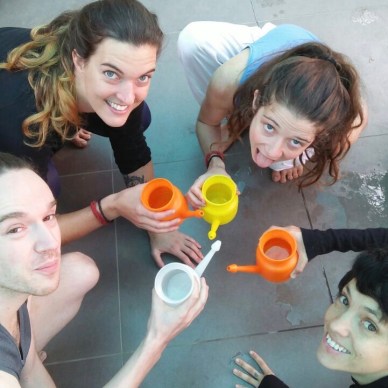
The cleansing techniques were considerably more testing to wrap our heads around.  We started off lightly; feeding salty water through the spout of our Jeli Neti pots: in one nostril, and out the other. This progressed to feeding a rubber tube up one nostril and out through the mouth. We amped up to digestion cleansing, one which involved drinking salty water, followed by a set of asanas, this promoted an almost instantaneous flush of the system. Some of these practices seemed unnecessary and daunting to my western mind, but I was always happy to give them a go and see the outcome. Every day, in almost every class we opened and closed with Om and Mantra chanting. Never before had I experienced the elevation that can be achieved through Om chanting, where your voice gets lost amongst the sounds of every other around you. It became one of my favourite experiences in the course. There was a fine line between the enjoyment and displeasure of Om chanting though, as it lied entirely on the syncing of voices, and could be an excruciating to the senses when the pitch was off. During meditation we would lose ourselves to the delightful chants for up to 10 short minutes, before being transfixed by the recurring voice of our teacher, coaxing us to relax into Shavasana.


As with many experiences in life, there were many ups and downs; this course more of less, surpassed my expectations in most ways. The assessment criterion was not daunting, it took place in a relaxed and supportive environment, which encouraged us to test our skills and try diverse teaching techniques. I appreciated the classes ranging from the physical to the spiritual. There were certain components that I didn’t necessarily agree with, for example yoga philosophy, which I akin to religion in many ways. But that is the beauty of yoga practice; it is to every individual a different experience and way of life, adopt from it what works for you. I set out to complete this training as a way to enhance my own practice, and build upon a set of skills, which could be used to share with my clients. My goal has been achieved, for I have been practicing regularly and cannot wait to get back to work, to share a class after a day on the trail.
 Compelling Trails
Recent Comments